Against Year-Round Availability: What Salmon's Spawning Clock Tells Us About Better Fish and Healthier Rivers
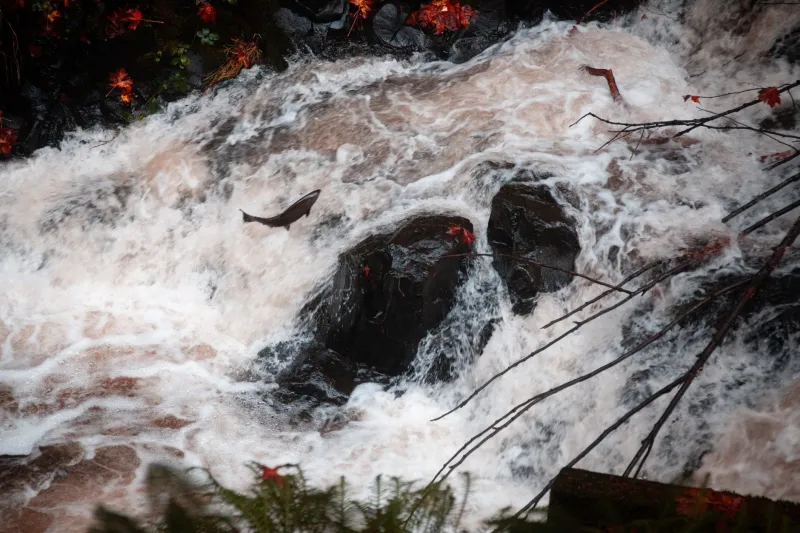
There is a quiet contradiction embedded in the modern seafood aisle. Salmon—wild, farmed, fresh, frozen, vacuum-sealed—appears at every turn, in every season, at every price point. The refrigerated case does not acknowledge spring or autumn. It does not observe the rhythms of the Kenai River or the Sacramento's tributaries. It simply offers fish, continuously, as though the ocean were a warehouse and abundance were a permanent condition rather than a carefully managed gift.
For consumers who care about where their food comes from, this seamlessness is worth interrogating. Wild salmon are not year-round creatures. They are seasonal ones—governed by one of the most precise and consequential biological clocks in the natural world. Understanding that clock does not merely satisfy scientific curiosity. It changes how you shop, what you taste, and whether the fisheries you depend upon will still be thriving a generation from now.
The Biology Behind the Calendar
Wild Pacific salmon—Chinook, sockeye, coho, pink, and chum—each follow distinct migratory and spawning timetables shaped by millions of years of evolutionary pressure. Chinook, the largest and most prized, begin entering West Coast rivers as early as late winter, with major runs peaking between May and September depending on the river system. Sockeye, famous for their vivid crimson flesh and high omega-3 content, surge through Alaskan waters primarily from June through August. Coho arrive later, with peak runs typically stretching from August into November.
These schedules are not arbitrary. They are synchronized with water temperature, snowmelt timing, ocean productivity cycles, and the developmental needs of juvenile fish. The salmon's body, in the months preceding spawning, undergoes a remarkable physiological transformation. Fat reserves accumulate. Muscle tissue reaches peak density. Flavor compounds develop in ways that cannot be replicated through aquaculture or off-season harvesting of fish that have not yet completed this biological preparation.
In short, salmon caught in alignment with their natural pre-spawn peak are categorically different from salmon caught outside that window—not merely in freshness, but in composition.
Why Pre-Spawn Fish Are Nutritionally Superior
The omega-3 fatty acids that have made wild salmon a cornerstone of evidence-based nutritional guidance are not static. They accumulate during the salmon's ocean feeding phase, reaching their highest concentrations in the weeks immediately before the fish begins its freshwater migration. A sockeye pulled from Bristol Bay at the height of its run in July carries a meaningfully different nutritional profile than one harvested outside that peak, or one raised in a net pen on a formulated pellet diet year-round.
Fat content, which drives both flavor and nutrition, fluctuates significantly across the season. Early-run fish are often leaner; mid-run fish, having fed intensively in cold, productive ocean waters, carry the richest reserves. Late-season fish, already redirecting energy toward reproduction and beginning the cellular breakdown that precedes spawning, offer a different eating experience—still valuable, but distinct from the mid-season pinnacle.
Flavor, too, follows this arc. The characteristic richness of a peak-season wild sockeye—that deep, mineral-forward complexity that farmed Atlantic salmon cannot approximate—is a direct expression of the fish's biological moment. Buying salmon in sync with these cycles is not a culinary preference. It is a decision to eat the fish at its most nutritionally complete and gastronomically honest.
Seasonal Scarcity Is a Conservation Signal, Not a Supply Chain Failure
The expectation of year-round salmon availability has been normalized largely by the aquaculture industry, which produces fish on demand and has trained consumers to view seasonal gaps as inconveniences to be engineered away. This framing deserves pushback.
When wild salmon are not available, there is a reason. Fisheries managers, working with biological data collected across decades, set harvest windows that correspond with run strength, escapement goals, and ecosystem capacity. These windows are not limitations imposed by an inefficient supply chain. They are the architecture of a functioning, self-renewing resource.
Escapement—the number of salmon that must reach their spawning grounds to sustain future populations—is the foundational metric of responsible fisheries management. When consumers demand salmon outside established seasons, the pressure to source from less rigorously managed fisheries increases. When retailers fill off-season gaps with farmed product or imports from jurisdictions with weaker oversight, the market signal that supports domestic, sustainably managed wild fisheries is diluted.
Embracing seasonal availability is, in this sense, an act of advocacy. It signals to producers, distributors, and retailers that the consumer understands the difference between a fish in season and a fish on demand—and values the former.
Reading the Season: A Practical Framework
For consumers navigating this calendar, a few general principles apply across most U.S. markets.
Alaskan fisheries, which supply the majority of domestically harvested wild salmon, operate under a compressed but intensely productive summer window. The months of June through September represent the core of the wild Alaskan season. Retailers and direct-to-consumer suppliers sourcing from these fisheries will typically offer fresh or flash-frozen product within that window, with frozen inventory extending access through the fall and winter months.
California's Chinook salmon, subject to its own management regime and the ongoing recovery efforts affecting rivers like the Klamath and Sacramento, operates on a separate and more variable schedule. When California Chinook seasons open—subject to annual assessments by the Pacific Fishery Management Council—they represent an opportunity to source genuinely local, ecologically significant fish. When they are restricted or closed, as has occurred in recent years due to low run counts, that restriction is itself meaningful information about ecosystem health.
For consumers who wish to eat wild salmon year-round without compromising their sourcing values, high-quality frozen wild salmon—harvested at peak season and processed immediately aboard or dockside—is not a compromise. It is the responsible choice. A sockeye frozen at sea in July retains the nutritional and flavor profile of peak-season fish far more faithfully than fresh-labeled salmon of uncertain provenance sold in February.
The Clock Is Also a Promise
There is something worth sitting with in the idea that the best salmon you will eat this year does not exist yet. It is still in the ocean, feeding, accumulating the fat reserves and flavor compounds that will make it extraordinary. It will arrive on a schedule that is not yours to set—only yours to respect.
This is not a limitation of wild seafood. It is its defining character. The spawning clock that governs when salmon run, when they should be harvested, and when fisheries should rest is the same mechanism that has sustained these species—and the communities that depend on them—across centuries. Working with that clock, rather than around it, is what separates a responsible sourcing decision from a convenient one.
At Golden Gate Salmon, we believe the consumer's relationship with wild fish should be built on that kind of understanding. Not the expectation of perpetual availability, but the deeper satisfaction of eating something that arrived at the right moment, caught by someone who knew what that moment meant, from a fishery managed to ensure it will come again next year.
That is what seasonal scarcity actually looks like. And it is worth waiting for.