When the Blindfold Comes Off: What a Chef's Rigorous Tasting Experiment Reveals About America's Salmon Illiteracy
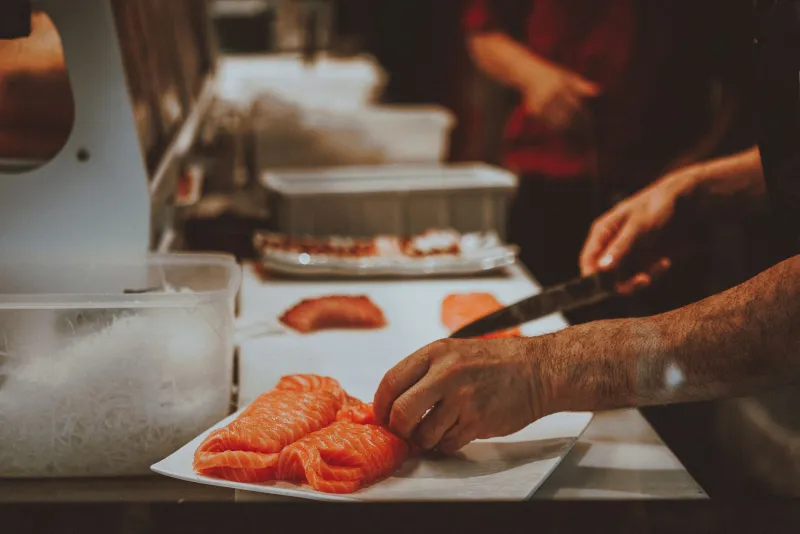
The plate in front of each taster held five unmarked portions of cooked salmon. No garnish, no sauce, no lemon wedge. Just fish. For Chef Miriam Valdez, who has spent two decades sourcing seafood for her acclaimed San Francisco restaurant, the exercise was more than a culinary curiosity. It was, she would later describe it, "the most clarifying thirty minutes I have spent in a professional kitchen."
Valdez had grown quietly frustrated. Her menu featured wild Alaskan sockeye, and she could articulate its virtues in confident, poetic language to her dining room. But she had begun to suspect that the compliments she received were, in part, the compliments of expectation — that diners were tasting the story she told them as much as the fish itself. She wanted to know what people actually perceived when the narrative was stripped away.
What followed was a methodical, months-long sensory project that ultimately reframed how she thinks about her sourcing, her customer education, and the quiet crisis at the center of American salmon consumption.
Designing the Experiment
Valdez partnered with a food science consultant and a panel of twenty tasters — a deliberately heterogeneous group that included trained culinary professionals, enthusiastic home cooks, and self-described "casual seafood eaters." The objective was not to produce peer-reviewed research, but to generate honest, granular sensory data from a cross-section of real consumers.
Five salmon samples were prepared identically: oven-roasted at the same temperature, for the same duration, with only salt applied beforehand. The selections included a Norwegian Atlantic farmed salmon purchased from a national grocery chain, a Chilean farmed Atlantic salmon from a warehouse retailer, a wild sockeye from Bristol Bay, Alaska, a wild king salmon from the Copper River in Alaska, and a wild coho from the Oregon coast.
Tasters scored each sample across four dimensions: color, aroma, texture, and flavor complexity. They were also asked an open-ended question: does this taste like something you would seek out again, and why?
The results, Valdez says, were not subtle.
The Findings: A Spectrum, Not a Binary
The two farmed samples clustered together in ways that surprised even the culinary professionals in the room. Both were described repeatedly as "mild," "buttery," and "inoffensive" — terms that sound like praise but, in the context of the experiment, revealed an absence of distinction. Several tasters noted that without visual cues, they struggled to confirm they were eating salmon at all. One participant wrote simply: "It tastes like protein."
The wild samples occupied an entirely different register. The Bristol Bay sockeye drew immediate reactions for its color — a deep, almost garnet red that tasters found startling against the pale pink of the farmed portions. Its flavor was described variously as "mineral," "oceanic," "clean," and "assertive." A home cook who had never knowingly purchased wild salmon wrote in her notes: "This is what I imagined salmon tasted like when I was a child."
The Copper River king salmon generated the most animated responses. Its fat content — wild king salmon carries a higher ratio of omega-rich lipids than nearly any other Pacific species — produced a richness that tasters found both familiar and revelatory. Unlike the farmed butter-fat quality, this richness arrived with complexity: a faint nuttiness, a long finish, a faintly sweet note that several participants attributed, correctly, to the fish's exceptional diet of cold-water prey in the Gulf of Alaska.
The Oregon coho was the group's most divided sample. Its leaner profile and more delicate flavor struck some tasters as sophisticated and clean; others found it understated compared to the sockeye. Valdez views this divergence as instructive. "Coho rewards attention," she said. "It is not a salmon that announces itself. And that means most people, eating distracted, will underestimate it entirely."
Why American Palates Have Been Shaped by Inferior Product
The implications of the tasting extend well beyond one chef's kitchen. Farmed Atlantic salmon now accounts for roughly seventy percent of all salmon sold in the United States. It is the default salmon in most grocery stores, the salmon in the majority of sushi rolls, the salmon at casual dining chains and hotel buffets. For a significant portion of the American population, farmed Atlantic salmon is salmon — the reference point against which all other fish is unconsciously measured.
This matters for reasons that are simultaneously sensory, ecological, and economic. When consumers cannot distinguish premium wild-caught salmon by taste, they lose one of the most powerful incentives to seek it out. The price premium that sustains responsible wild fisheries — the Alaskan fleet operators, the tribal fishing communities, the small-boat harvesters who depend on consumers valuing what they catch — becomes harder to justify in a marketplace where "salmon" means a mild, uniform, commodity protein.
Valdez puts it bluntly: "We have trained an entire generation to prefer a product that was optimized for consistency and yield rather than flavor. And we did it so gradually that most people don't realize there was ever anything to miss."
The Role of Water, Season, and Origin
One of the tasting's most compelling threads was the degree to which geography registered on the palate. The Bristol Bay sockeye and the Copper River king, despite both being wild Alaskan salmon, tasted demonstrably different — a distinction traceable to water temperature, migratory distance, and the specific prey available in each ecosystem.
This is not metaphor. The flavor compounds in salmon flesh — the fatty acids, the carotenoids absorbed from krill and amphipods, the mineral profiles absorbed through gill tissue — are direct expressions of the water a fish swam through and the food it consumed. A Copper River king, fattening itself for an arduous upstream migration, accumulates lipids in ways that a pen-raised Atlantic salmon, fed a manufactured pellet diet in a Norwegian fjord, simply cannot replicate.
Season compounds these differences further. Wild salmon harvested at peak run condition, just before or during their upriver migration, carry the full biological investment of years at sea. The same species caught off-season, or a farmed fish harvested on an industrial schedule, tells a nutritionally and sensorially diminished story.
Restoring the Standard
Valdez has since restructured how her restaurant introduces salmon to first-time guests. She now offers a small comparative tasting as an optional amuse-bouche — a single bite of the wild fish she serves alongside a frank description of what distinguishes it. The response, she reports, has been consistent: curiosity, followed by recalibration, followed by a kind of mild indignation that this quality was not the baseline all along.
That indignation is, perhaps, the most productive outcome a tasting like this can produce. Informed consumers are the most reliable engine of market change. When Americans understand — not abstractly, but through direct sensory experience — what wild-caught salmon from a responsibly managed fishery actually tastes like, the conversation about sustainable sourcing becomes far easier to have.
The blindfold, in other words, is the problem. Taking it off is where the real work begins.