Reputation on the Line: How Bay Area Chefs Are Staking Their Kitchens on Hyper-Local Wild Salmon
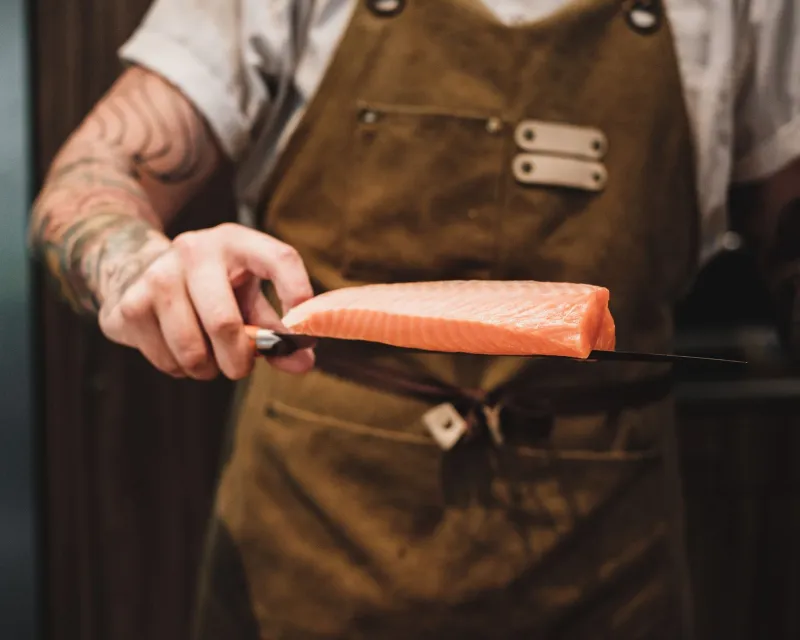
There is a particular kind of pressure that comes with cooking in San Francisco. The city's dining public is unusually well-informed, constitutionally skeptical of marketing language, and possessed of an almost civic devotion to knowing the origins of what arrives on their plates. For the chefs who have built careers in this environment, vague sourcing is not merely an ethical lapse—it is a professional liability. And nowhere is that accountability more acutely felt than in the sourcing of wild salmon.
In recent seasons, a meaningful shift has taken hold across Bay Area fine dining, neighborhood bistros, and upscale fish counters alike. Chefs are no longer content to specify Alaska or the Pacific Northwest in general terms. They are naming rivers. They are posting harvest dates on chalkboards. They are building direct relationships with individual fishing vessels operating within striking distance of the Golden Gate. The result is something that functions simultaneously as a culinary movement and a conservation argument—one that is reshaping how premium wild salmon is sold, celebrated, and protected in one of the country's most influential food markets.
Geography as Culinary Advantage
The Bay Area's relationship with the Pacific is not incidental. The region sits at the convergence of several of the West Coast's most storied salmon corridors, including the Sacramento River system, historically one of California's most productive Chinook runs. The proximity of these fisheries to one of the nation's wealthiest and most gastronomically sophisticated urban centers has created conditions for a market that few other American cities can replicate.
Chefs here do not need to imagine the distance between ocean and kitchen. On a clear morning, the fishing boats are visible from the Marin Headlands. That physical intimacy with the source has a clarifying effect on culinary philosophy. When a purveyor can deliver a salmon harvested the previous day from waters visible on the horizon, the conversation about freshness, provenance, and responsibility becomes far more concrete—and far more commercially urgent.
Several restaurateurs describe the sourcing decision as one that practically made itself once they understood the geography. Diners in this market do not simply prefer local product in the abstract; they reward chefs who can narrate the journey from water to plate with specificity and conviction. In that sense, hyper-local wild salmon has become a form of culinary credibility.
The Traceability Premium
For the chefs who have committed most fully to this model, traceability is not a marketing feature layered onto an existing supply chain. It is the foundation upon which the entire sourcing relationship is built. Several of the Bay Area's most decorated kitchens now work directly with named fishing families, receiving detailed documentation of harvest location, method, and date with every delivery.
This level of transparency carries a cost—in time, in relationship management, and often in price per pound. But the chefs who have embraced it consistently describe the investment as self-justifying. When a menu can honestly state that a Chinook was caught by a specific vessel operating under a specific permit in a specific body of water, that specificity commands both a price premium and a depth of diner trust that generic sourcing cannot approach.
Local purveyors have responded to this demand by building infrastructure specifically designed to serve it. A number of small-scale distributors operating in the Bay Area have positioned themselves explicitly as traceability specialists, working exclusively with fishermen who can provide harvest-level documentation and who fish in compliance with the most rigorous sustainability standards available. Their client lists read like a condensed guide to the region's most respected dining establishments.
Seasonality as Principle, Not Constraint
One of the more striking features of the Bay Area's hyper-local salmon culture is the degree to which chefs have embraced—and in many cases, actively celebrated—the seasonal limitations of wild fish. In a culinary world that has long prized year-round availability as a mark of sophistication, the deliberate construction of a salmon menu around a finite harvest window represents a meaningful philosophical departure.
The chefs leading this movement speak about seasonality not as a constraint to be managed but as a principle to be honored. When wild Chinook is available, it occupies a place of prominence on the menu. When the season closes, it disappears—and that absence is treated as meaningful rather than inconvenient. Several establishments have developed what amounts to a ritual around the arrival and departure of the season, communicating both moments to their regulars with a degree of ceremony that reinforces the product's value and the fishery's rhythms.
This approach has a secondary effect that extends well beyond the dining room. By treating seasonality as a feature rather than a flaw, these chefs are actively educating their clientele about the biological realities that govern wild fish populations. Diners who understand why salmon is unavailable in February are diners who are more likely to support the conservation policies that make the spring and summer runs possible.
Conservation as Brand Identity
The most sophisticated practitioners of the hyper-local model have come to understand that their sourcing choices function as a form of conservation advocacy conducted through commerce. Every premium paid to a small-boat fisherman operating sustainably is a market signal that responsible practices carry economic value. Every menu that names a river is a small act of public education about the ecosystems that produce wild salmon.
Several Bay Area chefs have formalized this connection by partnering with river restoration organizations, participating in advocacy efforts around water policy, and lending their public profiles to campaigns that support both wild salmon populations and the fishing communities that depend on them. The logic is straightforward: a chef whose reputation is built on access to exceptional local wild salmon has a direct material interest in the health of the fisheries that supply it.
This alignment of economic self-interest and conservation purpose is, in many respects, the most durable foundation on which sustainable seafood markets can be built. When the people with the greatest culinary influence in a given market have staked their professional identities on the continued availability of wild, locally sourced fish, they become powerful and motivated advocates for the policies and practices that protect those fish.
What the Bay Area Model Suggests for the Broader Market
The hyper-local wild salmon economy that has taken shape in the Bay Area is not, in its particulars, replicable everywhere. The geography is unusual. The concentration of culinary talent and food-literate consumers is exceptional. The proximity of major fisheries to a major urban market is a specific advantage that most American cities do not share.
But the underlying logic—that traceability, seasonality, and direct producer relationships can drive both culinary excellence and conservation outcomes—is transferable. What the Bay Area demonstrates is that when chefs treat provenance as a core value rather than a marketing afterthought, and when consumers are equipped to understand and reward that commitment, the market can become a genuinely effective instrument of environmental stewardship.
The Golden Gate has always been both a physical threshold and a symbolic one—the place where the Pacific meets the continent, where the wild meets the cultivated. That the region bearing its name has become one of the country's most compelling laboratories for sustainable seafood sourcing feels, in retrospect, entirely appropriate. The fish that pass through these waters deserve nothing less than the full weight of culinary reputation behind their protection.