Tasting the River: Building a Sensory Vocabulary for Wild Salmon
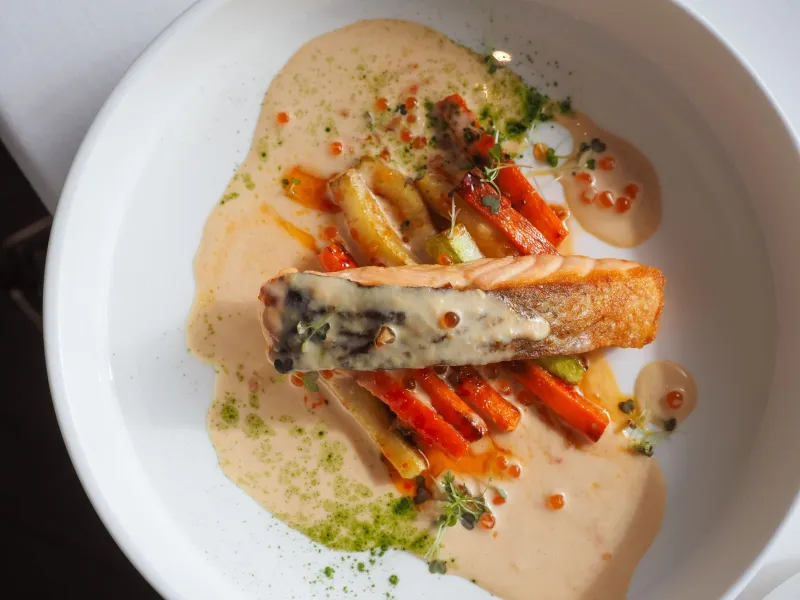
When a sommelier describes a Burgundy as expressing "forest floor minerality with a long, cedar-tinged finish," no one in the room blinks. The language is accepted, even celebrated, as a legitimate tool for understanding what the glass contains. Yet when a fishmonger attempts to distinguish a late-season Copper River king from an early-run Yukon Chinook by their respective fat distribution, flesh color, and finish on the palate, the conversation is still treated as novelty — a charming flourish rather than a serious act of connoisseurship.
That asymmetry is beginning to shift. Across American restaurant kitchens, specialty fish counters, and increasingly at the docks themselves, a growing cohort of professionals is constructing a rigorous sensory framework for wild salmon — one that borrows liberally from the wine and spirits industries while accounting for the unique biological and ecological variables that make each fish a singular product.
The argument, at its core, is straightforward: if wild salmon is to be valued, protected, and sourced responsibly, consumers need the vocabulary to perceive what they are eating. A tasting lexicon is not mere affectation. It is, in fact, a conservation instrument.
Why Language Matters for What We Eat
The wine industry understood decades ago that descriptive language drives purchasing behavior, loyalty, and ultimately producer investment. When consumers can articulate the difference between a mineral-forward Chablis and a butter-rich California Chardonnay, they make more deliberate choices — and they pay accordingly. The same principle applies, with equal force, to wild salmon.
Consumers who cannot distinguish Sockeye from Coho on the palate are, almost by definition, indifferent to sourcing. They will default to price, availability, and habit — three variables that consistently favor farmed Atlantic salmon over wild-caught Pacific species. Building a sensory vocabulary is therefore not a luxury reserved for fine-dining enthusiasts. It is a practical mechanism for redirecting market demand toward sustainable fisheries.
Several fishmongers operating in coastal markets have arrived at this conclusion independently. At specialty counters from Seattle to San Francisco, staff are increasingly trained not just to name the species and cite the catch region, but to walk customers through what they should expect to taste — and why.
The Five Dimensions of Wild Salmon Flavor
Adapting wine's evaluative framework to fish requires some translation, but the underlying architecture holds. Professionals working in this space tend to organize wild salmon's sensory profile across five primary dimensions.
Fat content and distribution functions much like body in wine. Chinook, or king salmon, carries the highest intramuscular fat of any Pacific species — a richness that manifests as a long, almost buttery finish and a flesh that yields to the fork rather than resisting it. Sockeye, by contrast, presents leaner, with fat concentrated more uniformly and a flavor that is correspondingly brighter and more assertive. Coho occupies a middle register: medium-bodied, approachable, with a clean sweetness that makes it a reliable entry point for developing palates.
Flesh color operates as a visual cue to diet and carotenoid intake. Deep vermilion in a Sockeye signals a diet rich in krill and other crustaceans; paler, more coral-toned flesh in a king may indicate different feeding grounds or timing within the run. Color is not a proxy for quality, but it is a meaningful data point in the sensory story.
Salinity and minerality reflect the fish's marine tenure. A salmon that has spent longer at sea before returning to spawn will often carry a more pronounced oceanic character — a clean brininess that some tasters describe as "coastal," analogous to the iodine-inflected notes prized in certain oysters. Fish caught early in a river run, still bright from the ocean, tend to express this quality most vividly.
Texture changes dramatically with season and proximity to spawning. Early-run fish, caught at peak ocean condition, offer firm, dense flesh with pronounced resistance — what chefs sometimes call "snap." Later-run fish, particularly those that have already begun their upriver migration, grow softer as their bodies metabolize fat reserves. Neither profile is inferior; they are simply suited to different preparations.
Finish — the persistence and character of flavor after swallowing — is perhaps the most wine-adjacent concept in the lexicon. A great king salmon, properly handled and cooked simply, can leave a finish that lingers for thirty seconds or more: a cascade of umami, sweetness, and faint oceanic salinity. A lesser fish, or one poorly handled at the dock, closes flat and quickly.
Regional Terroir: The River Speaks
The concept of terroir — the idea that place imprints itself on flavor — translates to salmon with perhaps more literal accuracy than it does to wine. A salmon does not merely grow in a place; it is constituted by that place. The mineral content of its natal river, the temperature and oxygen levels of the water column, the specific prey populations of its feeding grounds — all of these variables are metabolically incorporated into the fish's flesh.
Copper River kings from Alaska have developed a devoted following among American chefs, and not without reason. The river's extreme length and powerful current demand that returning fish carry extraordinary fat reserves — a biological adaptation that translates directly into the richness and complexity that tasters describe. Sockeye from Bristol Bay express a different register entirely: leaner, more vivid, with a mineral brightness that some associate with the region's cold, clear tributary systems.
Further south, California's Sacramento River system — now the site of significant restoration effort following years of dam removal and habitat work — produces Chinook with their own distinct character, shaped by warmer water temperatures and different prey assemblages. Chefs who have cooked both Alaskan and California kings consistently note the difference, even when preparation is held constant.
Teaching the Palate: What Fishmongers Are Doing
The most effective advocates for a wild salmon tasting vocabulary are not critics or writers — they are the people standing behind fish counters and expediting plates. Several fishmongers at Bay Area and Pacific Northwest specialty markets have developed informal tasting protocols for their staff, drawing on language borrowed from cheese, charcuterie, and wine to give customers a richer encounter with what they are buying.
The approach is deliberate and unpretentious. Rather than overwhelming a customer with technical terminology, a skilled fishmonger might simply note that the Sockeye on offer that week is "brighter and leaner than the king beside it — better for a quick sear with citrus, while the king wants lower heat and more time." That single sentence communicates species character, fat content, appropriate technique, and implied flavor profile — a compressed tasting note that educates without alienating.
Chefs working at the fine-dining level take the vocabulary further. Some maintain species-specific tasting journals, tracking how flavor profiles shift across weeks of a given season. Others conduct informal comparative tastings with their kitchen teams, building institutional knowledge about sourcing decisions and preparation variables.
The Conservation Argument, Stated Plainly
A consumer who can taste the difference between a wild Copper River Chinook and a farmed Atlantic salmon is not merely a more sophisticated eater. They are a more consequential market actor. Their preferences, aggregated across millions of purchasing decisions, determine which fisheries are economically viable, which responsible producers survive, and which ecosystems receive the commercial protection they require.
Building a tasting lexicon for wild salmon is, in the end, an act of advocacy conducted through the senses. Every time a consumer learns to articulate what they taste — to say, with some precision, that this fish is leaner, brighter, and more saline than that one, and that they prefer it — they are casting a vote for the rivers and oceans that produced it.
The language is not yet standardized. The vocabulary is still being assembled, argued over, and refined. But the project is underway, and it is one of the more hopeful developments in American food culture — a reminder that paying close attention to what we eat is itself a form of stewardship.