The River Remembers: How California's Klamath Is Bringing Wild Salmon Back to the Table
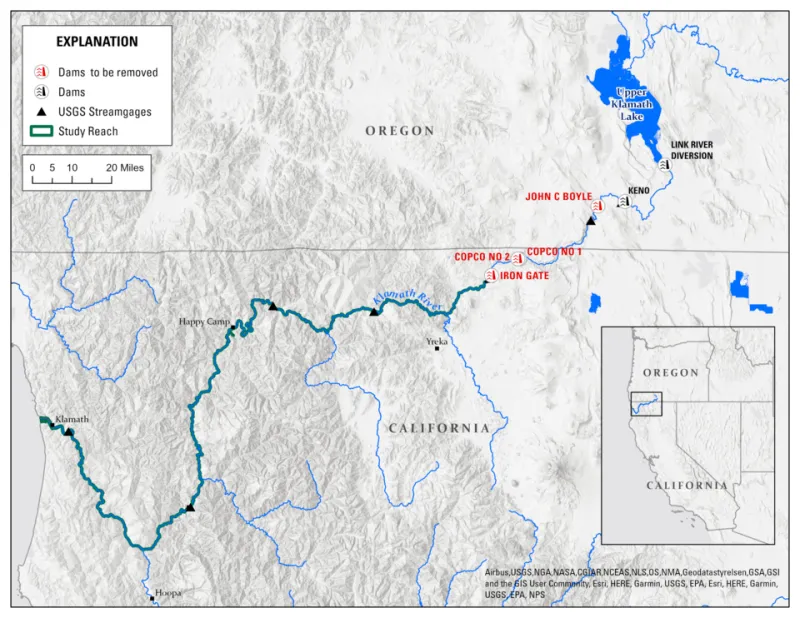
Photo: California Water Science Center, U.S. Geological Survey, Public domain, via Wikimedia Commons
On a cool morning in the fall of 2023, something happened along the Klamath River that no living person had ever witnessed. With four hydroelectric dams in the process of being dismantled—a project that would ultimately constitute the largest dam removal effort in United States history—Chinook salmon began probing the river's upper reaches for the first time since the early twentieth century. They were not yet returning in the numbers that the Yurok and Karuk peoples remember from their oral traditions. But they were there. And they were moving upstream.
For the communities who had fought for this moment across decades of litigation, legislation, and public advocacy, the sight was not merely symbolic. It was the beginning of a reckoning—a slow, complicated, and profoundly hopeful process of ecological and cultural restoration that is now, in measurable ways, beginning to reshape the relationship between California consumers and the wild fish on their plates.
A River Divided, a People Diminished
The Klamath River rises in southern Oregon and travels more than 250 miles before reaching the Pacific Ocean near the Northern California town of Klamath. For the Yurok Tribe—whose ancestral territory spans the lower river—and for the Karuk Tribe, whose people have lived along the middle Klamath for thousands of years, the river and its salmon runs were never separable from identity, ceremony, or sustenance.
The construction of Iron Gate, Copco 1, Copco 2, and J.C. Boyle dams between 1918 and 1964 effectively severed the river's upper watershed from its salmon populations, blocking access to more than 400 miles of spawning habitat. The consequences were not abstract. Salmon runs that had once numbered in the hundreds of thousands collapsed to fractions of their former abundance. Tribal fishing rights guaranteed by federal treaty became increasingly hollow as the fish themselves disappeared.
For decades, tribal leaders, commercial fishermen, and conservation organizations pushed for dam removal. The political and legal battles were exhausting, often demoralizing, and punctuated by setbacks that would have ended lesser campaigns. That they ultimately succeeded is a testament to the persistence of communities whose connection to the river was not negotiable.
The Science of Coming Home
Fish biologists who have monitored the Klamath since dam removal began describe the river's response in terms that border on the lyrical. Sediment that had accumulated behind the dams for generations began moving again, gradually rebuilding gravel beds essential for salmon spawning. Water temperatures in previously impounded sections—chronically elevated in ways that favored toxic algae blooms over juvenile salmon—began normalizing as natural flow regimes reasserted themselves.
"The river has a kind of ecological memory," explains Dr. Sarah Ohlund, a freshwater biologist who has studied Klamath salmon recovery since the early 2000s. "The habitat template is still there, encoded in the geology and the hydrology. Once you remove the barriers, the system begins to reassemble itself. It's not instantaneous, and it's not without complications, but the directionality is clear."
Early monitoring data from the first post-removal seasons has confirmed what advocates had long predicted: adult Chinook and coho salmon are accessing previously blocked tributaries, and juvenile fish survival rates in restored reaches are measurably improving. Full recovery—a return to the abundant runs of pre-dam history—will take decades. But the trajectory has shifted.
From Restoration to Revenue: The Consumer Connection
Restoring a river is an act of faith. Sustaining that restoration over the long term requires something more prosaic: money, political will, and the kind of broad public investment that only materializes when people understand what they stand to gain.
This is where California's food community has begun to play an unexpected but consequential role. A cohort of Bay Area and Northern California restaurants—guided by sourcing philosophies that prioritize regional, traceable seafood—has started building direct relationships with Yurok tribal fisheries and independent Klamath-adjacent fishing operations. By featuring Klamath-region wild salmon on their menus and explaining its provenance to diners, these establishments are doing something that no amount of advocacy literature can fully replicate: they are making the river's recovery legible and desirable to people who have never set foot on its banks.
Chef Miriam Estrada, whose Oakland restaurant has featured tribally harvested Northern California wild salmon for three consecutive seasons, describes the response from her guests as genuinely moving. "People want to know the story," she says. "When I tell them that the fish on their plate came from a river that was blocked for over a hundred years and is now running free again, and that buying it supports the tribe that fought to make that happen—they feel the weight of that. It changes how they eat."
The Economics of Ecological Recovery
The financial stakes are significant. Yurok tribal fisheries generate revenue that funds not only the fishing operations themselves but also the tribe's broader environmental monitoring, legal advocacy, and habitat stewardship programs. A strong market for premium Klamath-origin wild salmon—one that commands prices reflecting genuine scarcity, careful harvest, and verifiable provenance—directly underwrites the conservation infrastructure that the river's recovery depends upon.
State and federal restoration funding, while essential, is subject to political cycles and budget pressures that make long-term planning difficult. Market revenue, by contrast, is renewable and responsive to consumer behavior. Every restaurant that puts Klamath wild salmon on its menu, and every home cook who seeks it out at a specialty market or community-supported fishery, is casting a vote for the river's continued recovery.
What a Restored Watershed Tastes Like
There is a sensory argument to be made here as well, one that requires no ecological expertise to appreciate. Wild salmon from free-flowing, cold-water rivers—fish that have navigated genuine currents, fed on natural prey, and accumulated the fat reserves that long migrations demand—taste fundamentally different from farmed alternatives or from fish harvested in degraded habitat conditions. The flesh is firmer, the flavor more complex, the nutritional profile markedly richer in the omega-3 fatty acids that make wild salmon a genuinely functional food.
The Klamath's recovering runs are not yet abundant enough to supply a mass market, nor should they be. The appropriate response to a fishery in the early stages of recovery is not aggressive commercial exploitation but careful, tribally managed harvest that keeps the long-term trajectory intact. What is available, in limited quantities and at honest prices, represents something rare: a direct connection between a specific place, a specific community, and a specific act of ecological restoration.
A Legacy Worth Tasting
The Klamath River does not know that it has become a symbol. It does not know about the decades of courtroom battles, the federal negotiations, the engineering challenges of removing four dams from a working river without catastrophic downstream disruption. It simply flows, as rivers do, following the path of least resistance toward the sea.
But the people who fought for it know. The salmon beginning to probe its upper reaches know, in whatever way fish know things. And increasingly, the consumers who seek out its wild fish—who ask their fishmonger where a piece of salmon came from and listen carefully to the answer—are beginning to know as well.
That knowledge, translated into purchasing decisions and dinner table conversations and questions posed to restaurant servers, is one of the quieter but more durable forces now working in the Klamath's favor. The river is remembering how to be a salmon river. The least we can do is remember how to support it.